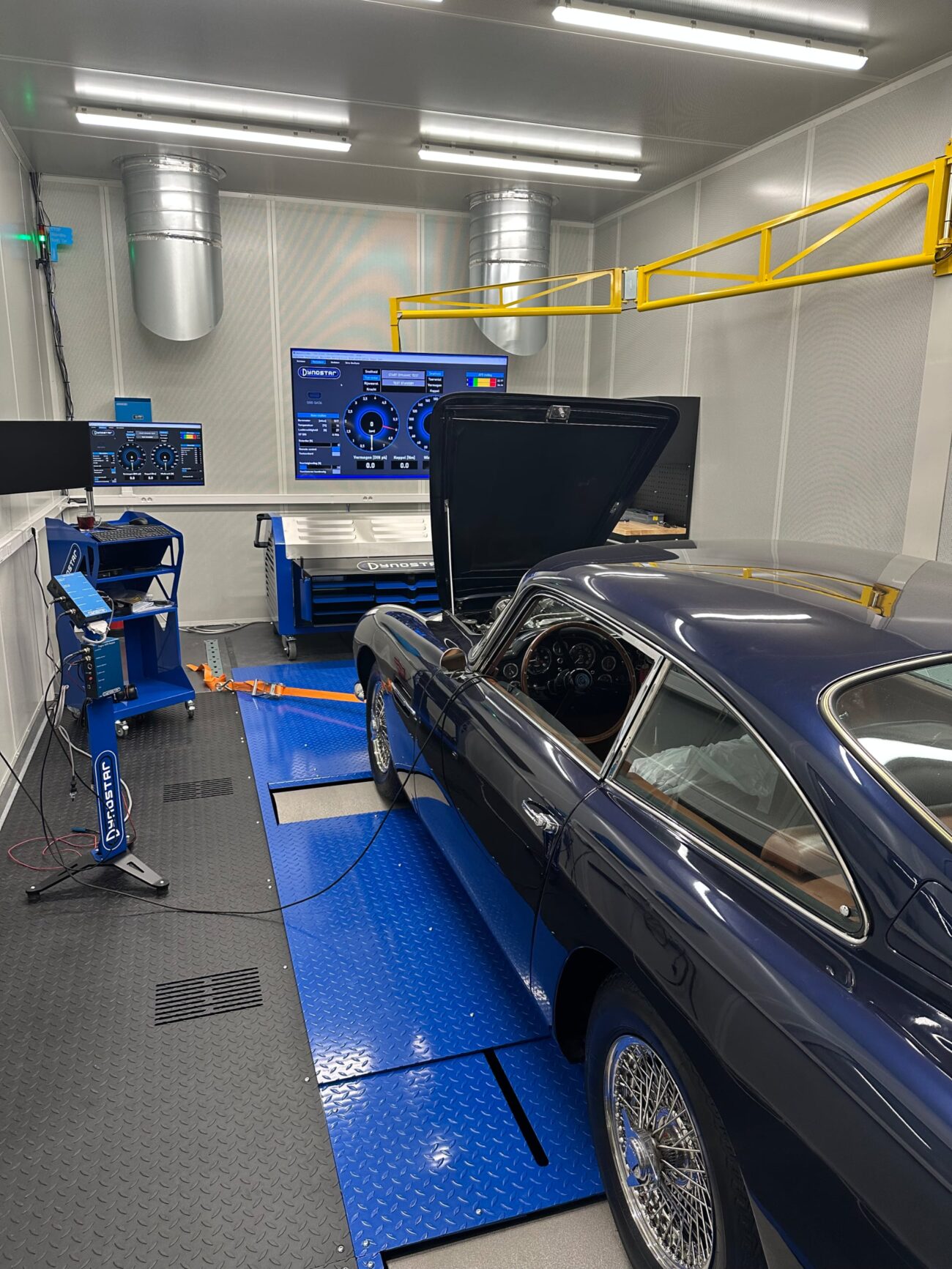
Aston Martin DB5

Factory specifications for this vehicle:
| Description | value | unit |
|---|---|---|
| Number of cylinders | 6 | |
| Boring | 96 | mm |
| Stroke | 92 | mm |
| Engine displacement | 3995 | cc |
| Power | 325 | BHP |
| Couple | 393 | Nm |
| Ignition sequence | 1-5-3-6-2-4 | |
| Compression ratio | 8.9 : 1 |
This Aston Martin DB5 Vantage was originally delivered in the Netherlands and has been owned by the same owner in the Netherlands for many years. The car was restored a few years ago. The previous owner had attempted to adjust the carburetors, but the result was not satisfactory.
The new owner wanted to improve the engine's performance.
The DB5 was brought to us for adjustment because the engine was stalling during acceleration and at constant speeds around 100 km/h. The cause turned out to be poor carburetor adjustment: each of the three had a different setup.
Before putting the DB5 on the test bench for measurements, we first checked the condition of the engine. Below is an overview of the inspections carried out:
- Compression test: passed; all cylinders showed an average compression of 10 bar.
- Oil quality & fluid levels: engine oil was at the correct level, as was the coolant level.
- Oil pressure: sufficient, between 3-5 bar.
- Ignition configuration & timing: conventional system with contact points. The contact point opening was correct, and the ignition was set to 10° before TDC (idling, around 600-800 rpm). The maximum advance was approx. 34-36° before TDC at 4,500 rpm, in accordance with the manufacturer's specifications.
- Carburetors: The Weber carburetors were checked, revealing that the jet settings were not the same on all carburetors.
The aim of the adjustment was to improve the acceleration phase and restore the driving characteristics of the DB5. The focus was immediately on the carburetors, due to the differences between the three carburetors.
After optimizing the carburetors, the car was tested on our own test bench.
-
During the first run, one of the carburetors proved to perform poorly in the transition phase. This resulted in the air-fuel mixture (AFR) being much too lean, which caused the engine to falter and perform poorly between 1,300 and 2,000 rpm. Overall, the mixture was too lean in this phase. The ignition also proved to be an important point of attention.
-
After checking the ignition cables, we discovered that several cables had excessive resistance, which negatively affected the spark strength. All ignition cables and the coil were replaced to restore the quality of the ignition. In addition, the carburetors were disassembled and inspected. The first carburetor had problems in the transition phase, caused by modified and damaged progression holes. The idle jets were also replaced with richer versions, identical for all three carburetors.
-
After these modifications, the problems during acceleration disappeared and the DB5 performed excellently.
We thoroughly enjoyed working on this DB5. The engine has been properly addressed in the most important areas, resulting in a reliable setup.